
I am a self-proclaimed ponderer. I like to take my time thinking things through before reaching any sort of conclusion. This habit of mine was challenged when I was tasked to complete a design sprint exercise this week. This project had me do something I NEVER do; time myself. Knowing that there’s a timer counting down as I’m thinking caused a touch of anxiety, but I am ultimately grateful for this opportunity to poke the overthinking, stuck-in-her-ways creativity bear.
In my last post, I discussed the five-step design thinking process, why it’s important, and how it’s been implemented in Mudurai, India. If you’d like to check it out, you can access it here. This will give you a better idea of what it’s like to put this process on steroids.
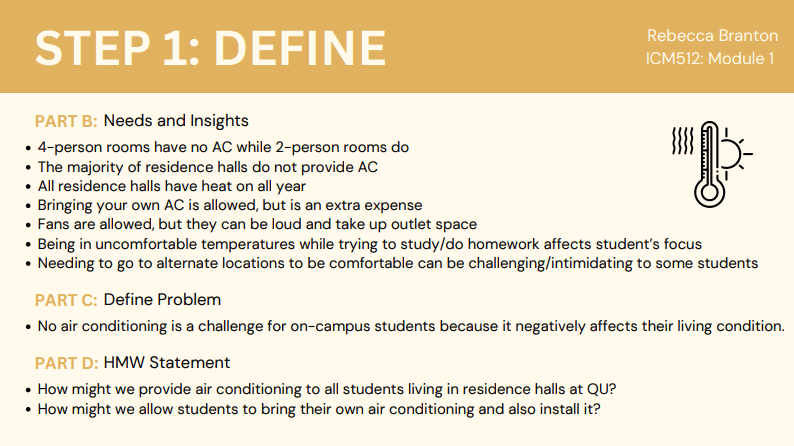
This challenge required me to interview someone who had a problem and needed a solution. I worked with a fellow Quinnipiac graduate student, Maeve, to complete the exercise. The focus was on issues involving our university, so I began by asking her about her experiences and potential problems she has faced while attending Quinnipiac.
She shared her experience with parking, residence life, and living on campus. When talking about the residence halls, Maeve casually mentioned that most of the halls do not have air conditioning. To say I was shocked is an understatement. As someone living in east Tennessee, the thought of living without air conditioning sparked fire up my spine. Consider me fully empathetic.
After asking a few follow-up questions, I moved into the second stage of the process and defined the problem; no air conditioning is a challenge for on-campus students because it negatively affects their living conditions. With that in mind, how might we provide air conditioning to all students living in residence halls at Quinnipiac?
I then began the ideation stage by doing a bit of research on how other universities provide air conditioning, what the typical cost of A/C units are, and what the most cost-effective option was. Here are some solutions I came up with:
- Provide one window unit for every two students.
- Install lock boxes on thermostats; only those with permitted access to the master key can adjust the temperature.
- Turn heat off May-October, and have it on November-April.
- Install blackout curtains in every bedroom
- Increase Room and Board fees to account for air conditioning installation.
- Have students request a window A/C unit at time of roommate selection.
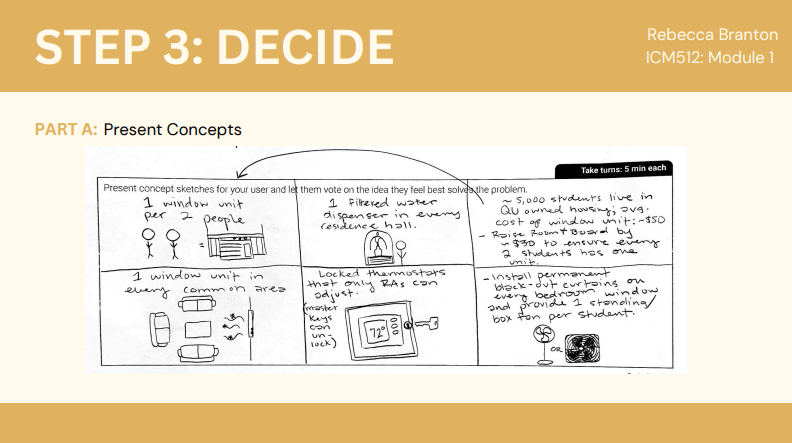
I presented these ideas to Maeve and received her initial feedback. She liked the option of providing one window unit per 2 students and increasing the room and board fees to account for installing the new units. She suggested viewing dorm tours available online so I can get a better idea of what the dorms look like and how many units would be needed. This would change the solution to having one unit installed in every bedroom, so single rooms would have access to air conditioning as well.
After receiving Maeve’s feedback, the idea of solar panels came to mind. Many of the residence halls are dated and might not have the infrastructure to run more air conditioning; solar panels are an option for the campus to use clean energy, lower utility costs, and act as a hands-on learning opportunity for students. This revision split my prototype into two parts:
- For every one bedroom, a window AC unit should be installed. By raising the Room and Board cost by ~$150 a person, this would cover the expense of the new units, solar panels, and labor to install over the course of a few years. This would provide every on-campus student with AC for their duration of their time at QU.
- Solar panels should be added over every parking lot across all QU campuses. This would help neutralize the use of AC units on campus. This doubles as shade protection for student and faculty cars. The panels would be easily accessible for maintenance and utilize vertical space.
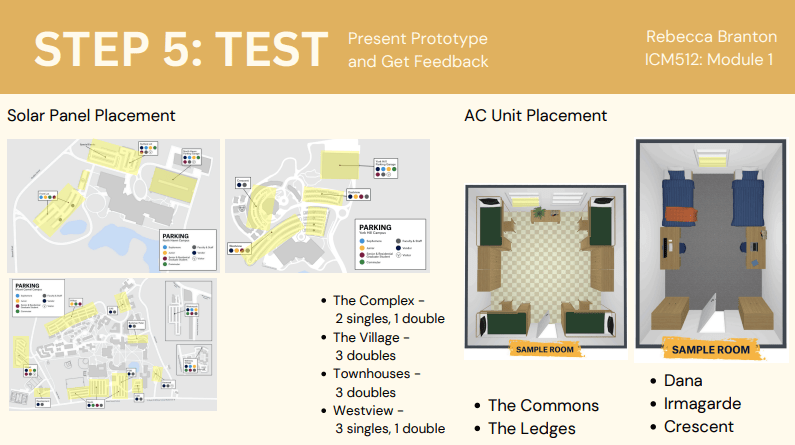
I then created and shared my final prototype with Maeve and received more feedback. She thinks the idea of having one unit installed per bedroom and raising room and board costs by ~$150 to account for the new units and solar panels is a solid solution. She states, “While parents may dislike the idea of cost increasing, I think they dislike their child being uncomfortable more.” She suggests that instead of adding structures to the parking lots for solar panels, the roofs of residence halls are easily accessible for maintenance and would utilize structures already on campus.
This idea would need a larger team to be fully developed and implemented, but for a timed design thinking exercise, I’m happy with what I developed as a solution to Quinnipiac University residence halls receiving air conditioning. To view my full presentation, click here.
 Rebecca Branton
Leave a comment