
Last week, I survived five days without TikTok. At first, I was mortified. How could I possibly go without it? Then, I became excited. Because it was an assignment, I had to hold myself accountable and make sure I stuck to it. Before, any attempt to lessen my social media usage was bogus. I was both tasker and tasked. In moments of weakness, I’d tell myself a few minutes of scrolling wouldn’t hurt… but it quickly turned into hours every time. Having an outside presence expecting me to complete the task was a tremendous motivation. And because I was able to make it five days, I decided to keep going.
I haven’t been on TikTok in 15 days, and I’m pretty surprised I’ve made it this far. I did have a few factors that made it easier to be offline, like going to California and not having access to Wi-Fi. What shocked me was that I didn’t really want to, even if I could’ve. I had beaches to explore, giant redwood trees to hug, and family to spend time with. Before learning about how social media is designed to keep me sucked in, I would’ve spent the whole trip freaking out about not getting my daily doom scroll.

A big part of my ability to stick it out this long is due to my view of social media being flipped on its head. The past few chapters of Stolen Focus felt like I was reading a confidential document that was never meant to be seen. After all this time thinking that I was unmotivated and had serious self control issues, I learned that the system in place surrounding social media is banking on my inability to turn the screen off.
Past Silicon Valley engineers and designers reveal the bloody, gutted underbelly of the tech industry. Tristan Harris, a former Google engineer, compares social media to magic tricks. “To learn magic is to learn to manipulate someone’s attention without them even realizing it – and once the magician controls their focus, he can do what he wants.” Moguls in the industry like Facebook, Snapchat, and Instagram are the magicians, and we’re the amazed audience cheering for more.
The whole industry is built on users’ engagement; our time equals their money. These companies are paid predominantly through advertisements. The longer we scroll, the more advertisements we see, and the more they get paid. On top of this, our behaviors are being tracked and sold to advertisers who want to target specific types of people. Aza Raskin, the (remorseful) developer of the infinite scrolling feature, compares the data collection process to creating voodoo dolls of each user. We are able to be cloned so well that when we think our phones are listening to us and sending ads based on what we say out loud, they’re actually based on scarily accurate predictions of what our data has provided them. This is called surveillance capitalism and is used by all major tech companies to increase their profits.
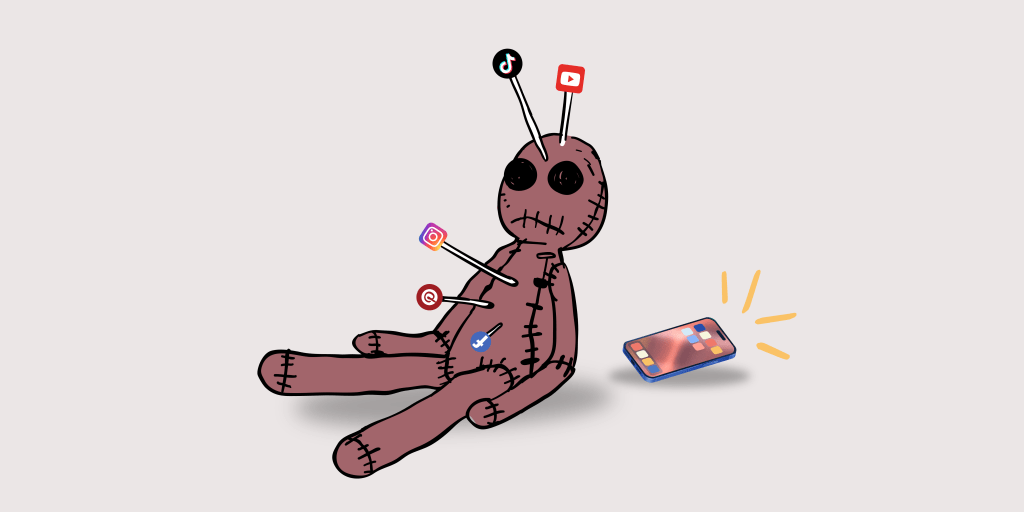
The business model of these companies is based on doing anything and everything they can to keep you on their apps. The worst part? This can easily be restructured to serve users positively and promote time away from devices. Although this seems impossible, Hari compares the daunting task to the 1970s issue of CFC in hairspray damaging the ozone layer. “Ordinary people absorbed this information and saw that it was true. Then activist groups – made up of ordinary citizens – formed, and demanded a ban.” When something proves to be damaging, it’s important to call attention to the issue and seek a proper solution. Because cyberspace is a relatively new landscape, there are bound to be unintended consequences. Acknowledging them and finding ways to make the tool serve us better is a necessary part of any technological advancement.
When I first started using TikTok, I had no idea how addictive it would become. Learning that the platform was designed to keep me in an attention chokehold and my actions are what strengthen its abilities leaves me uninterested in participating. I simply won’t allow myself to be manipulated and used for a company’s profit. I do think TikTok has good qualities, but it becomes brain junk food at a certain point. It’s my responsibility as a user to understand the risk I’m taking each time I open a social media app, but it’s the company’s responsibility to provide a safe service to its users.
 Rebecca Branton
Leave a comment