
As a designer, I’ve always thought I had a knack for developing creative solutions and sharing my ideas with others, but as I continue to look deeper into my abilities, I realize I’ve just scratched the surface of ideation possibilities. When I work individually, I can go about problem solving in any way that makes sense to me, which is usually sporadic notes that only I can decipher. Within a team, though, following certain methods makes the process easier for everyone to align with. When groups work together to ideate, it’s important for everyone to be on the same page. This is where ideation methods really come into play.
What are Ideation Methods?
Well, let’s first review the concept of ideation. According to the Stanford d.school, “ideation is the mode of the design process in which you concentrate on idea generation. Mentally it represents a process of “going wide” in terms of concepts and outcomes.” Basically, this is where the creative juices get flowing and you start jotting down ideas. Ideation methods are a tool used to help convey your ideas in a structured way that can be interpreted by others. When a team outlines their ideas in one type of structure, understanding other people’s ideas becomes easier.
Examples
To give you a better sense of what ideation methods entail, I’ve listed out ones that I found interesting and are able to complete individually.
Brain Dump :
For this method, you simply jot down any ideas that come to mind in the form of a list. The process of ideation promotes wild ideas and creative solutions, so don’t hold back!

Challenge Assumptions –
An important part of ideating is acknowledging assumptions that may be in place subconsciously. This method includes looking at elements of a project that may seem guaranteed and challenging their purpose to check if they are actively helpful components or if they hinder the project in any way.
Mind Map –
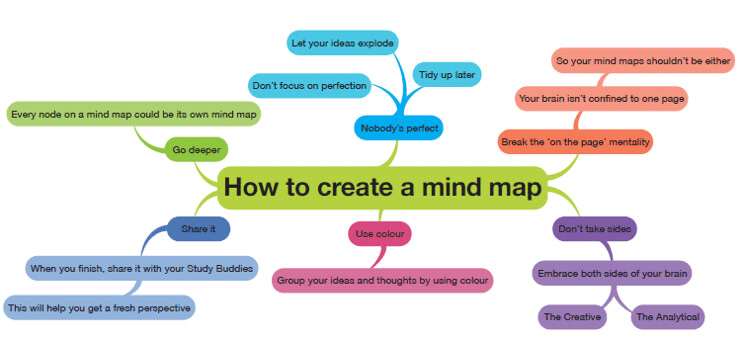
Mind mapping is similar to brain dumping, but this method takes on a visual structure. The middle of the map includes your topic, and branches extend outward to connect different ideas. This method is great for building onto ideas and making unique connections.
Sketch –
Instead of writing your ideas out, sketching allows the designer to draw what they’re thinking. This is one of my favorite methods because I prefer visual representations over text. Sketching gives a great sense to what a designer is picturing as a solution.
Storyboard –
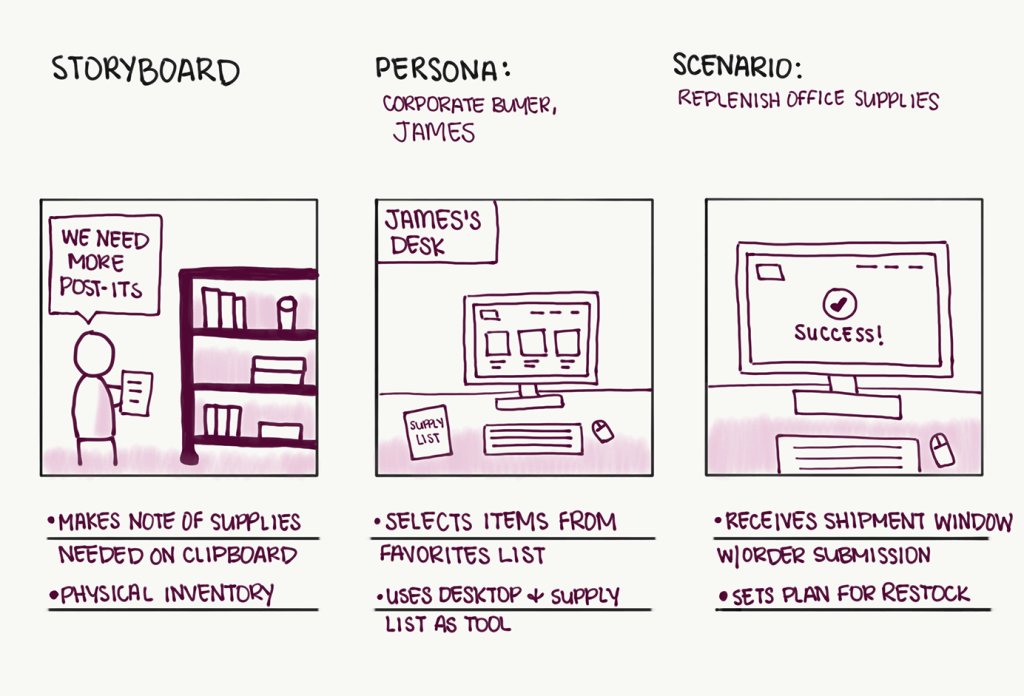
Similar to sketching, this method includes drawing out a scenario like a comic strip. Storyboarding gives the designer greater empathy for the user because it allows the designer to look at the issue from the user’s perspective.
Analogies –
Analogies are a great tool to convey what an issue might feel like for others. They compare two things that are typically unrelated and create a new connection. For example, saying “Wrench is to mechanic as chisel is to sculptor” would help mechanics realize the importance of chisels in a sculptor’s life. This method helps designers view the problem from a different perspective.
Provocation –
Similar to analogies, provocation encourages the designer to form ideas from unique angles and list unorthodox suggestions as a way to gain insight and create innovative solutions. This is where designers focus on overlooked aspects of a problem and come up with outside-the-box answers.
SCAMPER –
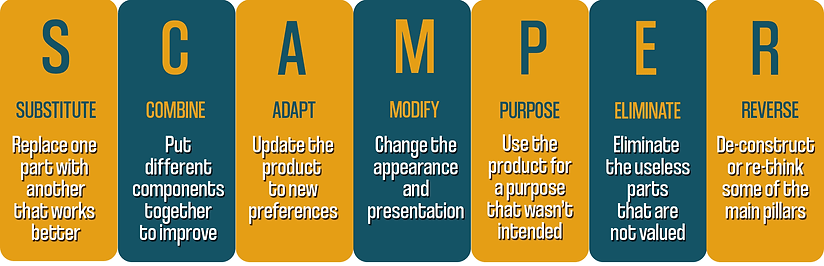
Scamper is an acronym for substitute, combine, adapt, modify, put to another use, eliminate, and reverse. By asking questions related to these verbs, designers can look at existing structures and create something new from it.
Anti-Problem –
This method is especially helpful when designers hit a block in generating ideas. Instead of focusing on the problem, you flip everything on its head and look at the opposite of your problem. Shifting attention can uncover new solutions that were previously unclear.
Cover Story –
For a cover story, designers sketch out what an ideal future state would look like as the cover of a magazine or newspaper. This method helps designers identify goals and hopes for a project by envisioning the ultimate solution to a problem.
Practicing Ideation Methods
To gain a better understanding of these methods, I put them to practice by incorporating them with my previous project about point of view statements. I tested out all the methods I listed above and included my thoughts on each. To view my full presentation on ideation methods, click here.

 Rebecca Branton
Leave a comment