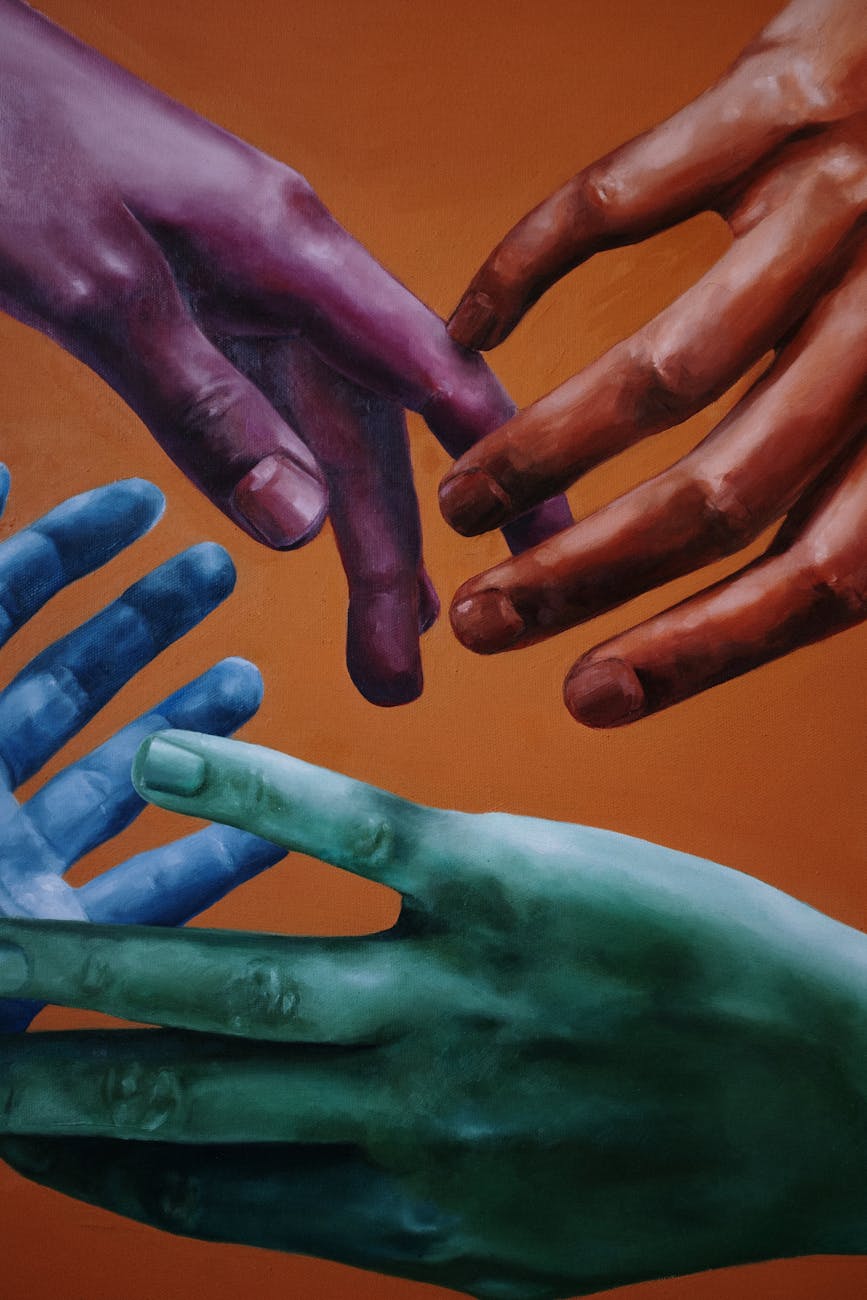
There is no better feeling than coming across a visual work and creating your own version of what the piece means. Visual storytelling is all about sharing stories and ideas through visual media, like paintings, photography, films, and digital art. It combines things like images, colors, and composition to create a narrative that grabs people’s attention and connects with them emotionally.
The importance of visual storytelling lies in its ability to cut through language barriers and communicate complex ideas. Since humans are naturally drawn to visuals, our brains process images faster than words, making visual narratives a powerful way to capture interest and evoke unique feelings for each viewer.
Visual storytelling can create immersive experiences that help audiences relate personally to a subject. It invites people to interpret the images in their own way, leading to deeper understanding and reflection.
In various areas—like advertising, education, and the arts—visual storytelling is used to inform, persuade, and inspire. Whether it’s conveying social messages, exploring personal stories, or just telling a good tale, it’s a crucial tool for communication, shaping how we see and understand the world around us.
I recently took some time to break down some of my favorite artworks and explore their potential messages:
The Irritating Gentleman
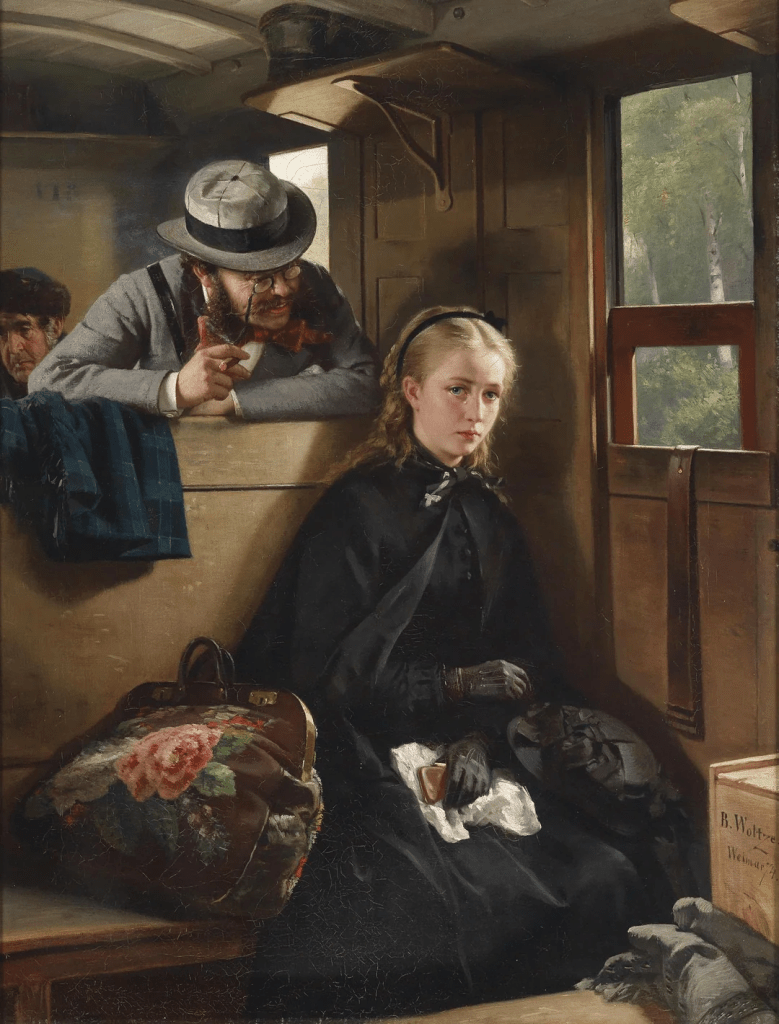
At first glance, Berthold Woltze’s painting The Irritating Gentleman simply depicts a man and girl on a train. The man’s coat is thrown over the back of the girl’s seat and he leans over her with a lit cigar in his hand, causing her to sit up and away from her back rest in an attempt to distance herself. The close proximity of the man and girl suggest that they have been on the train for a decent amount of time; the man has had time to set his stuff down, invade her space, light a cigar, and likely ask her a few questions that evoked a nervous tear to form in her eye. The girl is dressed in all black, with her golden curls loose over her shoulders. She could be returning from or traveling to a funeral. The man looks down at her with a slight grin, but she looks at the viewer with a tear threatening to roll down her cheek. The painting could be from the artist’s direct perspective; the wooden box with his last name and pair of gloves resting in the bottom right corner could suggest that he is a passenger on the train witnessing the interaction. The girl clutches a wallet and tissue in one hand, and seems to be reaching for her hat with the other. Hat pins were a common accessory for ladies at that time, and when feeling threatened, women would use them to prick violating men. Her silent plea to the viewer seems like her last attempt to dissolve the harassment before using her hat pin.
The Hesitant Fiancee
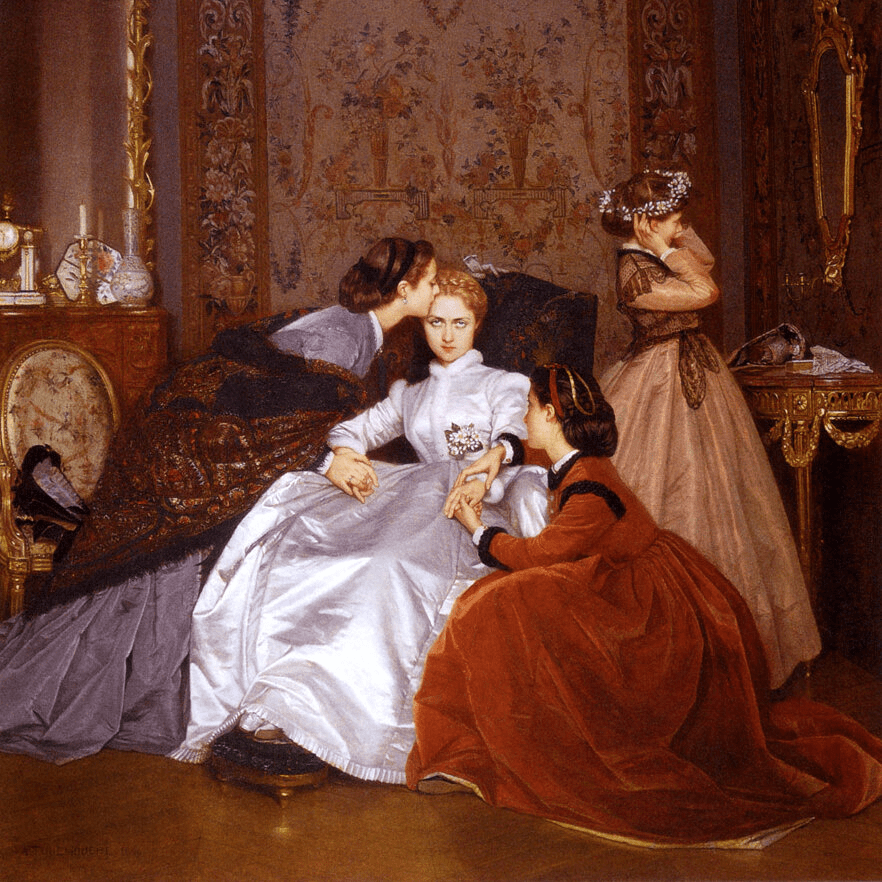
Auguste Toulmouche’s painting The Hesitant Fiancée captures a moment filled with emotion and tension. The scene depicts a young bride sitting in an ornate, lavish room surrounded by three other women. The bride’s loose body language suggests she is not excited about her upcoming marriage. She stares plainly at the viewer with an unamused look. She holds the other ladies’ hands loosely while they grasp onto her. The two women seem to be reassuring her about the marriage in an attempt to lift her mood. The third woman stands looking at herself wearing a headpiece, suggesting she is excited to dress up for the event or she is dreaming of her own wedding. dressed in an elegant wedding gown. Her expression is one of uncertainty and hesitation, suggesting inner conflict about her impending marriage. The painting conveys themes of societal expectations, the weight of tradition, and the complexity of personal choice. Toulmouche’s attention to facial expressions and posture invites viewers to reflect on the bride’s internal struggle, making it a powerful commentary on the nature of marriage and gender roles.
2000 Yard Stare
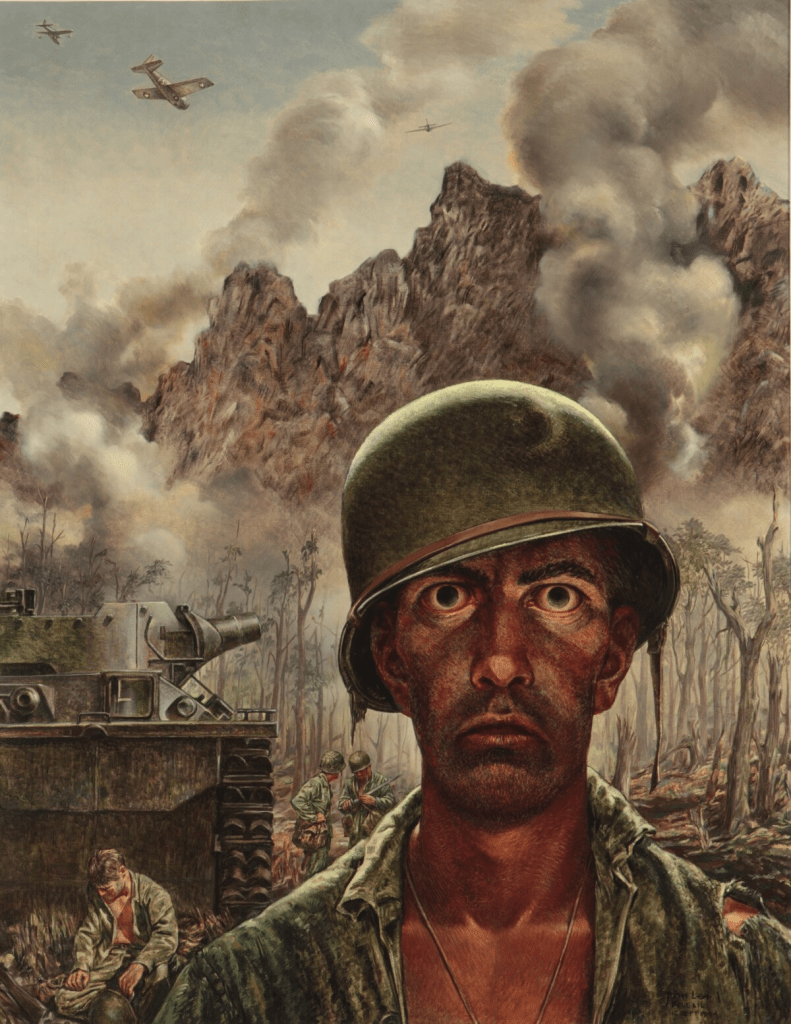
Tom Lea’s painting 2000 Yard Stare powerfully captures the emotional toll of war on soldiers. The central figure is a weary soldier, gazing into the distance with a haunting, vacant expression. His eyes convey deep trauma and the psychological scars of combat, suggesting a disconnect from his immediate surroundings and an overwhelming sense of loss and terror.
The background is stark and muted, enhancing the soldier’s isolation. This juxtaposition highlights the contrast between the chaotic reality of war and the profound internal struggles faced by those who serve. The title itself references the distance soldiers often mentally retreat to, a place filled with memories of battle and the weight of their experiences.
Overall, Lea’s work illustrates the psychological impact of war, emphasizing themes of suffering, resilience, and the often unseen scars that soldiers carry long after the fighting has ended. The painting serves as a reminder of the personal sacrifices made in conflict and the enduring impact of those experiences.
Christina’s World
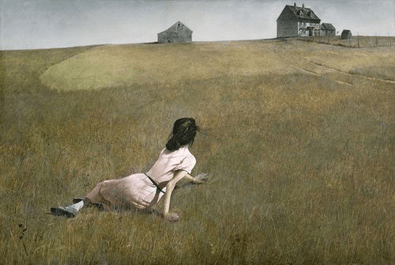
Andrew Wyeth’s painting Christina’s World depicts a young woman lying in a field, gazing towards a distant farmhouse. The scene is infused with a sense of longing and isolation, as Christina is portrayed in a moment of quiet contemplation. Her back is twisted in the opposite way of her knees as she holds herself up with thin arms. Her palms press into the grass as she digs her fingernails into the soil, suggesting that she is tense and seeking leverage to move her body.
The vastness of the landscape, with its muted colors and expansive sky, emphasizes her physical limitations and emotional state. The farmhouse, a focal point in the background, represents both a place of comfort and a reminder of what is just out of reach. Christina’s gaze conveys a mixture of determination and wistfulness, capturing her desire to connect with her home while acknowledging the struggle it takes to get there.
Wyeth’s attention to detail, from the texture of the grass to the soft light of the setting, creates an intimate atmosphere that invites viewers to empathize with Christina’s experience. The painting suggests themes of resilience, yearning, and the complex relationship between the individual and their environment, making it a profound piece on both physical and emotional landscapes.
The Swing
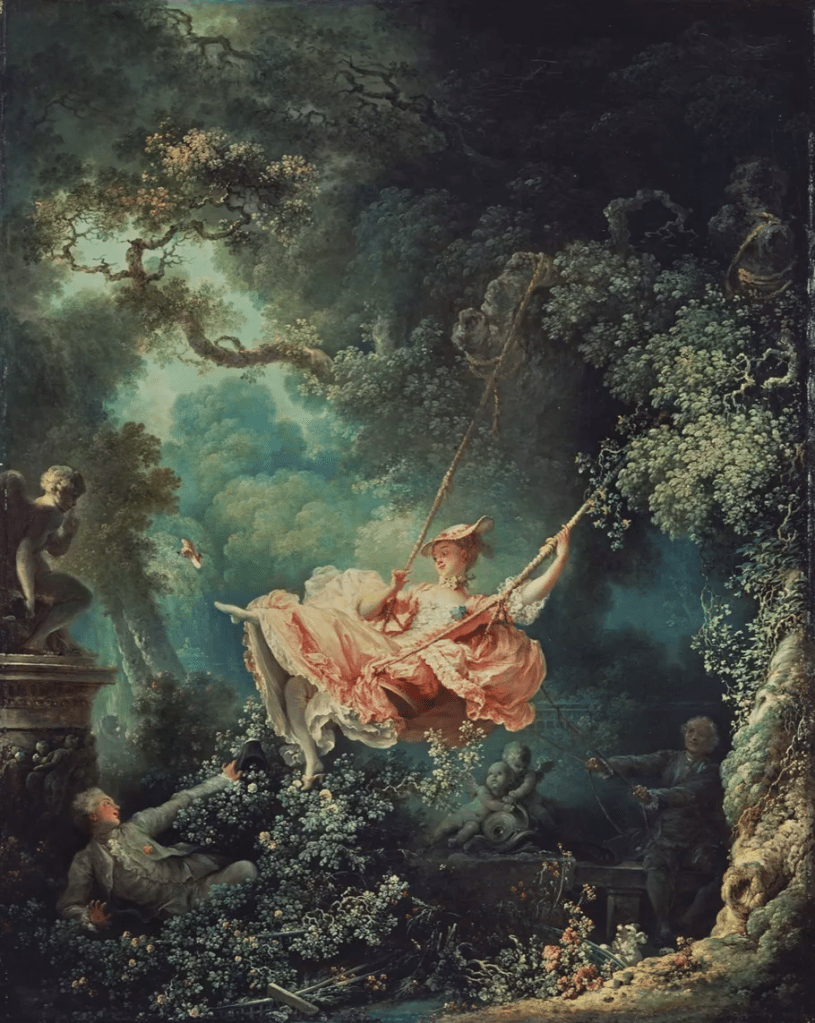
Jean-Honoré Fragonard’s painting The Swing depicts a playful and flirtatious scene of a young woman on a swing, dressed in a lavish gown that billows around her as she swings through the air. Her sweet smile and carefree demeanor convey a sense of joy and youthful exuberance.
In the foreground, a young man hidden in the brush gazes up at her, his expression revealing a mix of admiration and desire. The presence of an older man, possibly her expected husband or father, pushes the swing, unaware of the younger man beneath her. She gazes down at the younger man and flips off her shoe, adding to the flirtatious interaction. The rope of the swing is beginning to fray, which could represent her loss of innocence or love for the older man. The cupid statue holds a secretive pose so as to not reveal her hidden love interest. This dynamic creates an atmosphere of intrigue and mischief.
Fragonard’s use of light, color, and movement enhances the sense of enchantment, with soft pastels and lush greenery engulfing the scene. The overall composition conveys a moment of lighthearted indulgence and youthful romance, where innocence and playful deception intertwine.
Daddy’s Lap
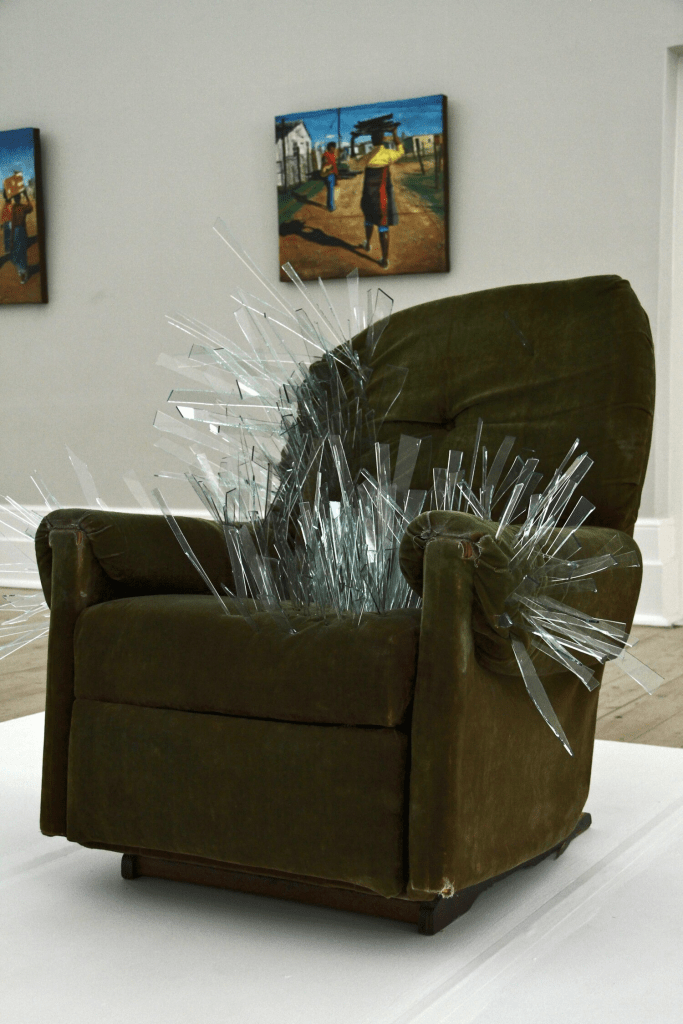
Bongani Njalo’s installation Daddy’s Lap is a large, worn-down recliner with large shards and spikes of glass protruding from the armrests and cushions of the chair. The placement of the glass is likened to the areas that would come in contact with someone’s body upon sitting down, suggesting that the person who typically takes a seat there shares similar characteristics as the glass: intimidating, hurtful, and unforgiving. This piece explores themes of paternal relationships, power dynamics, and domestic abuse. The installation typically incorporates elements that reflect the complexities of fatherhood, such as personal artifacts, photographs, or symbols that represent familial bonds. This interactive component encourages viewers to reflect on their own experiences with father figures, highlighting the nurturing and protective roles that fathers can play, while also acknowledging the emotional weight and damaging expectations that come with masculinity. This piece suggests that the artist does not find warmth and comfort from his father, but instead feels threatened and hurt by his father’s behavior.
Visual storytelling is imperative to communicate in spite of language or cultural barriers. Evoking emotions and encouraging connection between viewers singlehandedly creates a broad understanding of potential messages. Sharing ideas and life experiences through visual communication promotes empathy and the realization that at our core, humans are all connected.
 Rebecca Branton

Leave a comment