
As society becomes more technology-driven, users crave experience-based services now more than ever. With the ease of online shopping and food delivery services, customers mostly venture out to experience something new. Design plays a key role in this shift, and creating memorable experiences is now a crucial part of a designer’s process.
What is an Experience Economy?
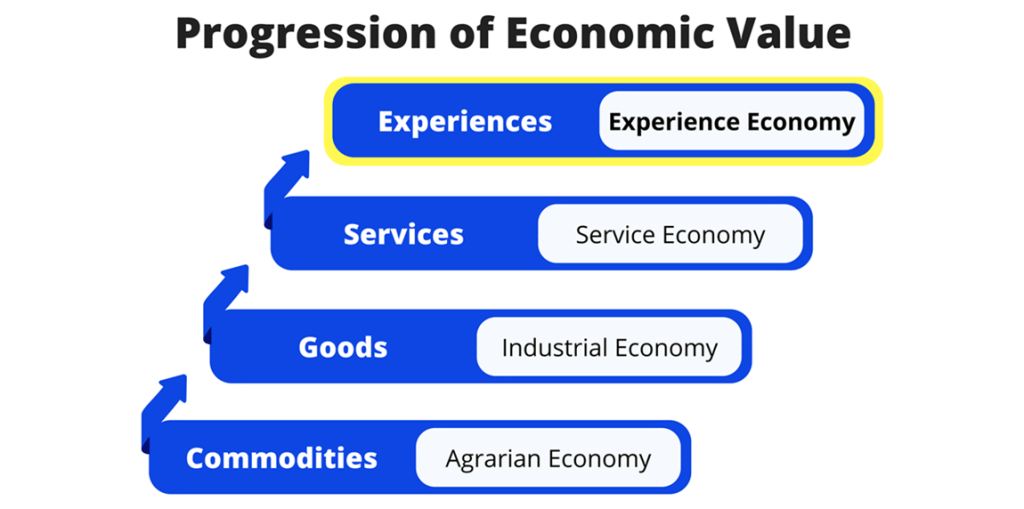
The concept of the experience economy, first popularized by B. Joseph Pine II and James H. Gilmore, co-founders of Strategic Horizons LLC, suggests that businesses are shifting from selling goods and services to providing memorable experiences. As people get busier and move toward a faster-paced lifestyle, paying for staged experiences in addition to materials is preferred. Similar to buying furniture, paying extra for assembly and delivery is well-worth the additional cost. Instead of experiences being lumped in with service, it acts as a service in itself. As businesses transition from offering purely transactional services to providing meaningful experiences to customers, design becomes a key vehicle for generating value.
Design’s Role in an Experience Economy
As we move away from creating designs that prioritize functionality, we must cater to those who are looking for emotional engagement. How an experience is perceived depends directly on the design’s execution.
Design is not just limited to the visual appeal of a product; it encompasses every aspect of how the product or service is perceived and interacted with. It includes visual, tactile, auditory, and aromatic elements that stimulate the senses and create a connection. Whether it’s the shape of a product, the sound it makes, or the texture of the materials, design is a powerful tool in shaping a consumer’s emotional response.
The role of design in the experience economy is to introduce consumers to the type of experience they can expect to have and to uphold that message throughout the experience; in a nutshell, design is what shapes the story. It plays a vital role in the anticipation, execution, and aftermath of a customer’s experience.
Regardless of the product or service, design is used to guide a user through their experience and unify their reactions.
How Design Adds Value Through Emotional Connections
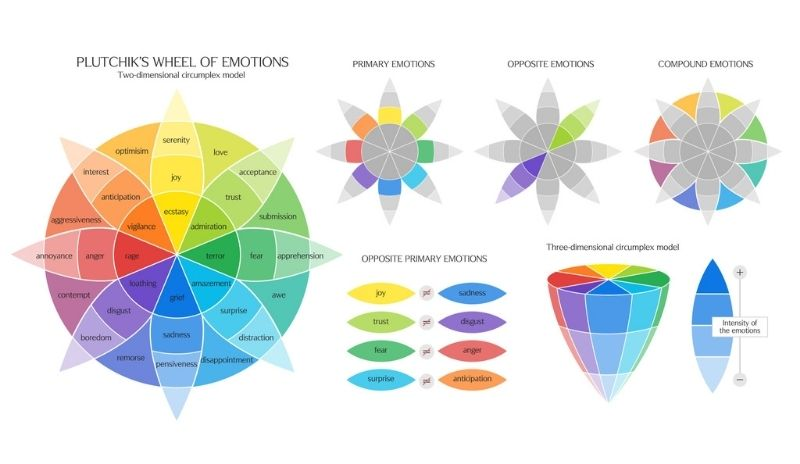
As the experience economy continues to grow and improve, it is crucial for the design field to expand on methods that add value to a brand or company’s mission. A key way to achieve this is by designing to evoke certain emotions. One resource that helps designers kickstart their process is Plutchik’s Wheel of Emotions. Robert Plutchik, an academic psychologist, introduced the concept of eight basic emotions in 1980. The wheel shows the relationships between those emotions and the differing levels of intensity they can have.
Promote Certain Emotions with Color and Typography
Other considerations designers should take involve color and font psychology. These elements are as important for graphic design as nouns and verbs are for sentences; they can single-handedly tell a customer what they can expect from a product or service. Warm tones generally promote energetic feelings while cool tones evoke calming emotions. Different typefaces like serif and sans serif often produce opposing connotations as well.


The execution of design directly affects the success of a product, service, or experience. By intentionally choosing certain colors and fonts, designers can create emotion-driven design that captures users and deepens their connections with a product, service, or experience.
 Rebecca Branton
Leave a comment