
Another week has passed since I began my distraction detox – one that no amount of lemon water can fix. Before I say anything, remember, progress isn’t linear. On a positive note, I do think I’ve used my phone a little less this week. Any time I pick it up, I picture a Ben Grosser-style stopwatch eagerly waiting to start the minute I open TikTok. If I do end up doom scrolling, I reach a point where I think, “Is this girl showing me how to do a slick-back ponytail any different from the thirty I just watched?” This usually sends a guilty heat down my spine, and I close the app.
Although it seems I’ve made small strides in acknowledging and breaking my habit, my screen time app tells me differently. Last Sunday, I picked my phone up 58 times. A week later, it’s 79. I give myself a teensy bit of grace since it’s the weekend, but spending one of my days off scrolling doesn’t make me feel great.
I was reminded of the reasons for my detox when I read a few more chapters of Stolen Focus: Why You Can’t Pay Attention and How to Think Deeply Again by Johann Hari. In chapter four, Hari discusses his issues with sustained reading. I’ll admit, knowing that an author also struggles to read like he used to is comforting, but learning that this is likely an issue for everyone is unnerving.

Hari explains, “Every time a new medium comes along – whether it’s the invention of the printed book, or TV, or Twitter – and you start to use it, it’s like you are putting on a new kind of goggles, with their own special colors and lenses.”
So basically, I’m adapting to the technological environment around me? This doesn’t sound like a bad thing, but it has destructive effects on our ability to remain focused on a task for a sustained period of time. Now that we have the world at our fingertips, we can’t help wanting to know everything all at once, or as Michael Harris puts it, “craving mental Tabasco sauce.” Despite this, maintaining our ability to sustain our focus is just as important as skimming an article quickly to gather the main points. The ability to switch depending on the situation lies in how well we can activate our flow state.
I was introduced to the concept of flow states through David Robinson’s article on the subject. If you have issues maintaining your focus and settling into a task, harnessing the power of your flow might be the solution. The term was coined by Mihály Csíkszentmihályi, a Hungarian psychologist of the 1970s, after interviewing hundreds of people on the best and worst moments of their lives. He found that at people’s highest moments, there was a level of mental focus involved that required the individual to become voluntarily immersed in an act. True magic happens when we find the perfect level of challenge for our abilities.
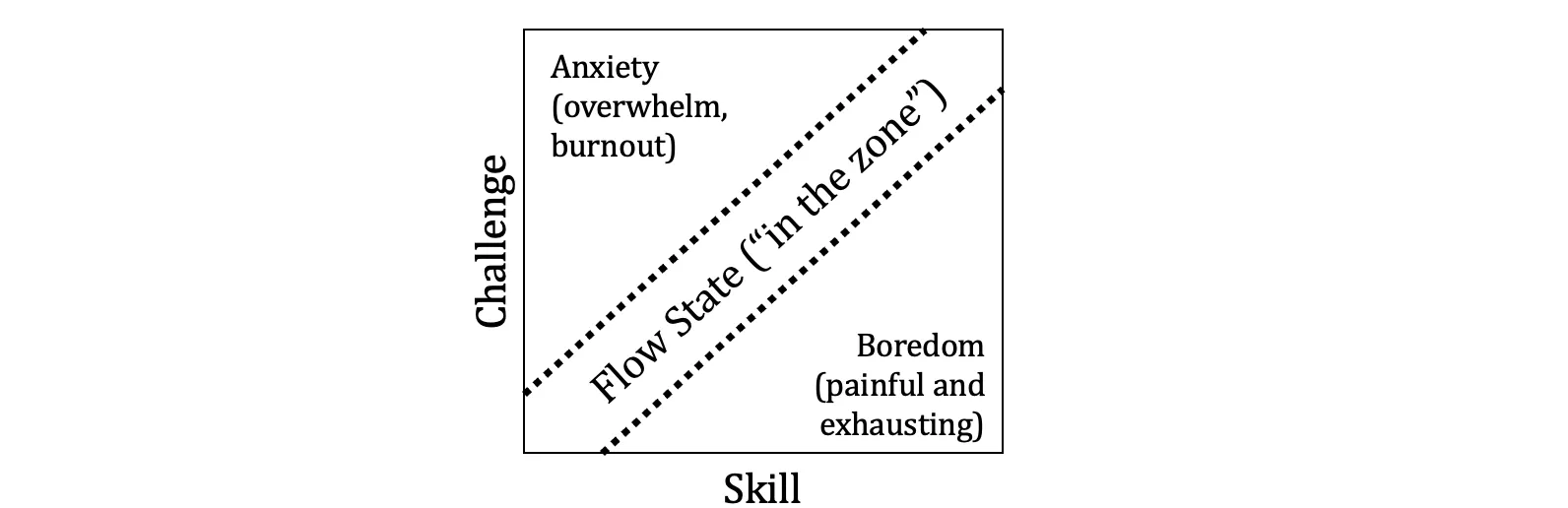
The hard part is that you can’t necessarily force it; many different factors have to line up just right in order to unlock your flow state. The good news is, there are tools that can help us find the flow no matter what our mood may be.
Kit Kuksenok developed a simple system that allows him to match tasks with his current energy level. He combines the Eisenhower Matrix, a method to identify the importance and urgency of a task, with the flow theory.
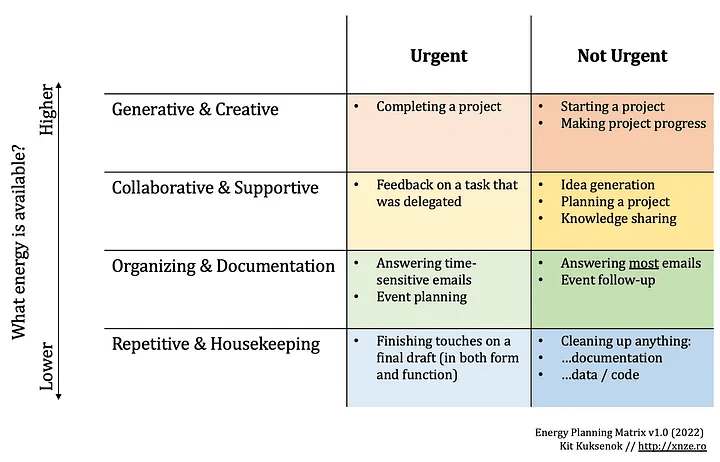
He calls his matrix the Energy Planning Matrix. He does disclaim that many of the items in the “Urgent” and “Not Urgent” sections are closer in importance than the matrix lets on. He uses the “Not Urgent” section to list tasks that require less focus and energy. This organization tactic is completely customizable depending on your needs and states of mind, so really, the matrix is your oyster. And for those of you that relate to my inability to keep a tidy planner, this is a simple way to lay out what you need to accomplish on a daily or weekly basis.
I’m excited to implement this tool in my daily routine and continue to customize it to fit my needs. The journey to a more focused and productive mind is a long one, but I’m ready to unlock my flow; give me a minute to chug some lemon water and buff my goggles.


Leave a Reply